

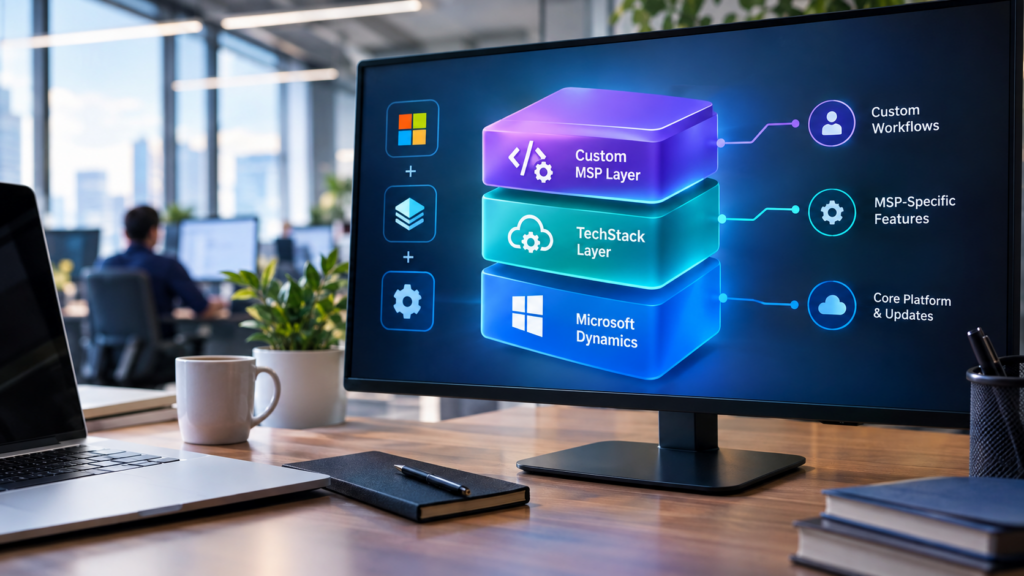
The episode highlights a structural shift toward MSPs considering custom-built operational core systems on enterprise platforms, rather than relying purely on traditional packaged PSA (Professional Services Automation) vendors. This approach is illustrated by ITECH Solutions’ decision to migrate from a legacy PSA system—augmented by multiple third-party tools—to a platform built on Microsoft Dynamics, leveraging TechStack as a custom layer for MSP functionality.
A key development discussed is ITECH Solutions’ experience with the limitations of existing PSAs. According to Brian J. Weiss, the lack of mature APIs and aging software architectures led to workflow inefficiencies and cumbersome tool proliferation. By selecting Microsoft Dynamics and partnering with TechStack, ITECH Solutions aimed to build a purpose-built, role-based system without maintaining a full in-house development team. Weiss described this as a hybrid model: Dynamics provides the core enterprise environment, TechStack develops the MSP-focused PSA features, and ITECH Solutions manages its own customizations, all within their own Microsoft tenant.
Supporting details reinforce the complexity and risk profile of this approach. Customization introduces three operational layers: Microsoft’s base (with ongoing feature releases), TechStack’s PSA-specific additions, and further MSP-specific custom work, all requiring maintenance and version management. The cost structure relies on Microsoft partner licensing and as-yet-undetermined pricing for TechStack’s development and support. While automation and workflow adherence are key selling points, Weiss noted that operational maturity—including process standardization and thorough documentation—is a prerequisite for success with this model; smaller MSPs or those with incomplete processes may face difficulties replicating the approach.
For MSPs and IT leaders, the implications revolve around vendor dependency, operational complexity, and governance oversight. Relying on multiple layers (Microsoft, TechStack, and in-house customization) adds resilience against single-vendor lock-in but shifts accountability for support, updates, and platform stability. Contractual risk increases as MSPs must track not just vendor but also tenant-layer modifications and integrations. While this structure offers customization and data control, it requires MSPs to have strong internal processes and governance frameworks to avoid operational drift or unintended consequences from layered system changes.